


Nonprofits face a series of interlocking crises in the second Trump administration. Most obviously, there are broadsides from the White House: indiscriminate funding cuts for human services providers, targeted pressure campaigns and cuts to research funding for higher education, threats to investigate and prosecute left-leaning philanthropies.
But this challenge is layered on top of a deeper crisis of trust.
“The hidden crisis facing nonprofits is declining public confidence in the sector,” writes longtime nonprofit executive Greg Berman in his new book, The Nonprofit Crisis. “If nonprofits don’t reverse the trend line soon, they may be hit with a stark lesson: once trust has been lost, it is exceedingly difficult to regain.”
In this forum, we ask a range of thinkers to weigh in: What kind of internal stewardship can see the sector through this volatile period? What kind of structural changes might be necessary? How can nonprofits respond to hostile funding disruptions and illiberal threats and simultaneously engage in self-examination?
The trust collapse and the nonprofit sector
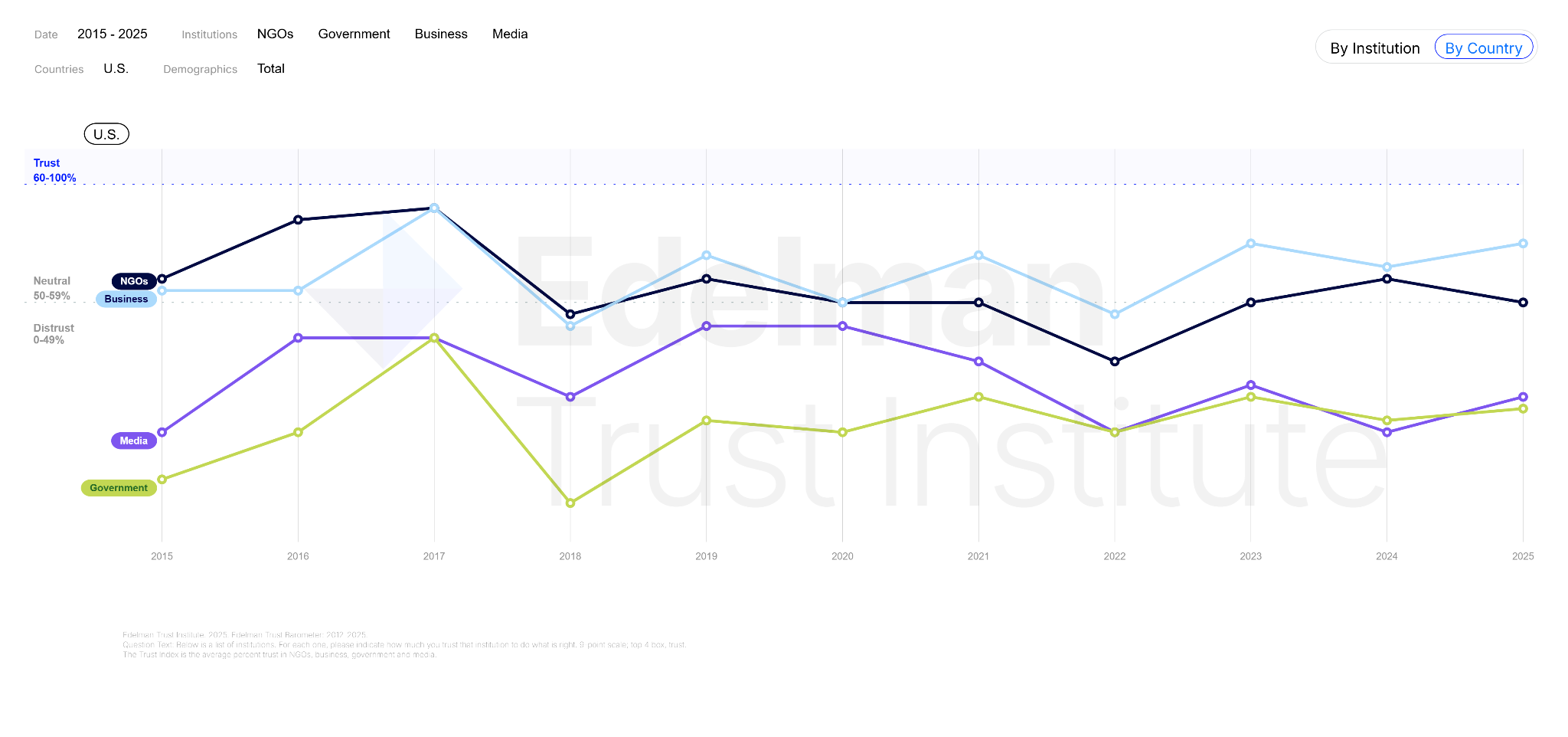
Survey data on nonprofit trust is limited, as you might expect for a sector that ranges from athletic rec leagues to giant health systems. The Edelman Trust Barometer found that as of 2025, faith in nonprofits hovered only in neutral territory, several notches below business, after hitting a nadir of “distrusted” in 2022.1
Edelman research conducted for the trade group Independent Sector shows a brighter topline, with about 57 percent of Americans expressing “high trust” in nonprofits every year from 2021 to 2025. Gallup’s trust polling does not ask about “nonprofits” in general, but three pillars of the sector – higher education, the medical system, and organized religion – all register trust levels under 40 percent.
Of course, it is not surprising that faith in nonprofits should be wavering in an environment where virtually all institutions have experienced a 50-year collapse in trust. In their 2022 survey of the cross-institutional trust decline, Henry Brady and Thomas Kent wrote: “One-third [of the decline in trust] might come from nonpartisan factors such as increasing [societal] inequality and diversity, leading to anomie that undermines trust in nearly all institutions among all groups.” That kind of macro trend is certainly beyond any organization’s control.
But the authors note: “One-third might come from partisan factors related to the emergence of cultural, social, and identity issues in American politics that have implicated nonpolitical institutions.” Here, the aperture for controlling one’s own destiny widens; organizations can make at least some choices about how they position themselves around such issues.
And finally, the authors speculate, “one third of the overall decline in trust might be due to specific events and experiences with institutions” — issues like poor performance, perceived violations of ethics, and the like. The media environment of the 21st century has probably raised the bar by exposing flaws more ruthlessly and rapidly than ever before, but nonprofits surely can do their utmost to meet the new expectations.
Steady hands in a shifting world
The nonprofit sector did itself no favors with its response to the first Trump administration, Berman argues in a passage excerpted from his book:
Many, if not all, of the organizations that embraced resistance the last time around ended up doing real long-term damage to the nonprofit sector by allowing themselves to be seen as explicitly political actors. Indeed, if a full-fledged battle for public support were to break out between Donald Trump and American nonprofits and foundations, Trump would be the likely winner.
Notably, many organizations face this fraught moment with inexperienced leadership. But if they are looking for inspiration, Eboo Patel offers an unlikely model: Alice Waters, the legendary chef whose Berkeley, Calif., restaurant Chez Panisse helped to transform America’s food culture through the farm-to-table movement:
Because Chez Panisse was excellent, it inspired the right people to also want to be excellent. And the secret to Chez Panisse’s excellence was total alignment around mission. Every role was executed in the service of fresh, delicious food in a comfortable environment.
At the same time, organizations already reeling under funding cuts may need to brace themselves for the possibility that there will be no return to the status quo ante. Nonprofits were vulnerable to the second-term assault from a hostile administration because in the last 60 years, conservatives and liberals teamed up to create “a public-private hybrid system of service provision,” explains Daniel Stid of the American Enterprise Institute.
The hybrid system’s demise is not something we can attribute only to the administrative tornado that is the second Trump administration. Tracing the system’s historical evolution indicates that its sudden toppling resulted from mounting contradictions that, like so many termites, ate away at its foundations and legitimacy for decades. In light of these accumulated problems, we should not try to salvage the old hybrid system. But we can reimagine it — and now have little choice but to do so.
Finally, John MacIntosh of the nonprofit-banking provider Seachange argues that nonprofits should neither flatter themselves by assuming they are of much interest to our mercurial president, nor sell themselves short by wondering if their day-to-day work matters when liberal democracy itself is being attacked:
Our mere existence as a largely autonomous bastion of noneconomic, diversified, politically unrewarding, civic endeavor demonstrates the limits of political power.
The structure of America’s nonprofit sector may be up for renegotiation. The focus and performance of many organizations surely needs sharpening. That is work Americans can surely embrace as they yearn for a vital public space between politics and the market.
David Dagan is director of editorial and academic affairs at the Niskanen Center.