


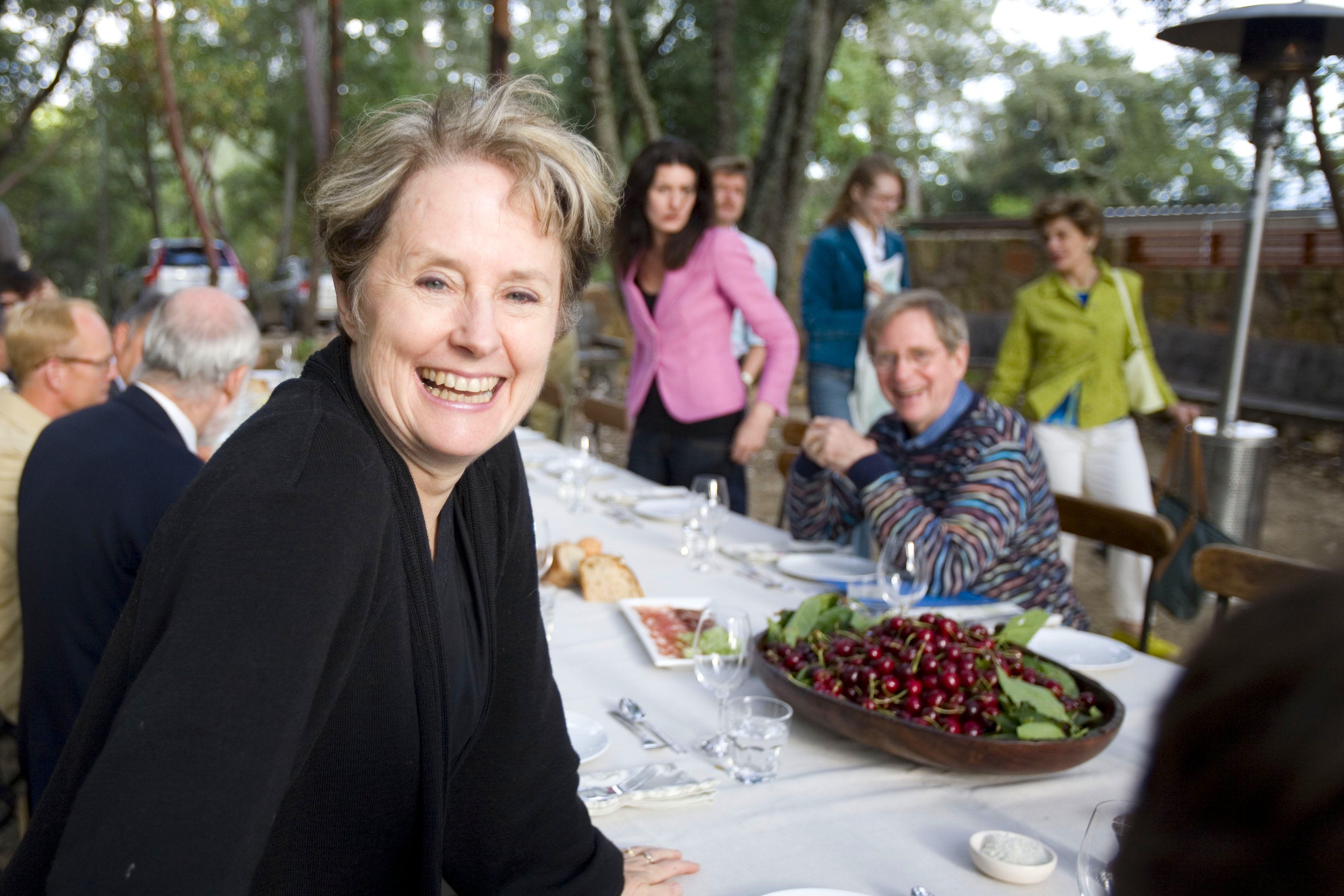
Alice Waters grew up in post-World War II America, the first era of mass market processed foods. Meals for her generation typically came from the freezer or out of a can.
When Alice went to France in 1965, she experienced a whole new food culture. People went to the market regularly to find the freshest food available. They were happy to pay extra for the good bread. One day, Alice went to a restaurant in Brittany and ordered fish for lunch. As food writer David Kamp recounts, her waiter, part of a husband-and-wife team that owned the place, went out back and caught a trout from the stream that ran alongside the restaurant. He showed Alice the fish while it was still alive and flopping around. Then his wife cooked the fish with vegetables that she had picked from the couple’s garden. This was trout amandine, the French way.
When Alice returned to Berkeley, she knew she couldn’t go back to the way she had grown up eating. She wanted serious change when it came to food. She had developed a passion, and she wanted to build an institution to cultivate it. Her goal was not scale; it was excellence. She wasn’t driven by anger at the system; she was motivated by love for an ideal. She didn’t go to McDonalds and suggest they put riper tomatoes on their Big Macs. She started Chez Panisse.
Chez Panisse was the nation’s first farm-to-table restaurant, the pioneer of “California cuisine.” It serves a prix fixe menu of meats and vegetables with only the freshest ingredients prepared in an open kitchen using French-inspired techniques. Chez Panisse has a claim to be the most influential American restaurant of the past 50 years. A whole galaxy of famous chefs got their start in its kitchen. From Whole Foods, to organic vegetables, to knowing the name of the farm that provided your steak — our universe of food stems from Chez Panisse.
The restaurant represents an approach to social change that David Brooks calls the “some people find a better way to live, and other people follow” way. Because Chez Panisse was excellent, it inspired the right people to also want to be excellent. And the secret to Chez Panisse’s excellence was total alignment around mission. Every role was executed in the service of fresh, delicious food in a comfortable environment. The farmers knew how to raise livestock and grow vegetables that would taste fantastic. Waters and her leadership team knew how to select the right array of fresh meat and produce and arrange the bounty into creative and interesting meals. The line cooks knew how to cut the vegetables and prepare the meats for maximum freshness and flavor. The chefs were excellent at cooking the dishes. The servers knew how to explain the menu to the restaurant’s patrons in an accessible and fun way. And the patrons knew what they were getting when they walked through the door. It would not be quick. It would not be processed. It would not be cheap.
Organizations build trust by doing what they say they are going to do. Organizations squander trust by failing to do that.
In Greg Berman’s excellent book, The Nonprofit Crisis, he underscores the central importance of nonprofit organizations excelling at their mission. “The hidden crisis facing nonprofits is the declining public confidence in the sector,” Greg writes. Organizations build trust by doing what they say they are going to do. Organizations squander trust by failing to do that.
And then Greg points out that many nonprofits fail precisely where Chez Panisse succeeded — alignment. He relates story after story of nonprofits whose executives say the organization is doing one thing, while program staff or participants are actually doing another. In one story, Berman recalls speaking to a group of Coro Fellows about the importance and challenges of creating alternatives to incarceration. All the Fellows wanted to talk about was structural racism. Berman’s point: Of course structural racism is an important factor in incarceration, but if you want to create alternatives, you have to put the work into designing alternatives and then building them. The people around the table were not interested in learning how to do that.
In another example, two baby boomers started an organization called Youth on Boards, Action on Climate to help young people be good board members of environmental organizations. The effort fell apart because the founders of the organization wanted to teach young people how to hire, fundraise, and set organizational priorities. The young people they were trying to train wanted to focus on calling out harmful systems of power. Again, misalignment. People were not willing to excel at their role in an agreed-upon mission.
I have been a part of this problem. My first job out of college was at an alternative education program that prepared high school dropouts to pass the GED exam, so they could get a high school equivalency credential. It was a small school, with four teachers and about 40 students. I introduced myself to the students by quoting Paolo Freire and telling them they had been victims of racist systems of education and that I was there to raise their consciousness about oppression. A student approached me afterwards, thanked me for my inspiring words, and said that the last teacher he’d had in the program had said much the same thing. He had failed the equivalency exam that year. He wanted to make sure that wasn’t going to happen again. He had a new baby boy and having a GED meant he would make a dollar more an hour at Cub Foods. Was I a good enough teacher to help him pass the exam?
I could feel myself sweating as he spoke. The truth was that I had never prepared students for an exam before, and I had no idea how to. The program had lost its entire staff a few months earlier, and had to hire new people quickly. I had shown up at the right time, showed the proper enthusiasm, and was basically hired on the spot. My speech about racist education systems was one part conviction and one part bluster: I was scared to death that my lack of teaching skill would be discovered.
A friend of mine who serves as a consultant to nonprofit organizations agreed wholeheartedly with Greg’s analysis of the nonprofit crisis. His experience consulting with nonprofits could be summarized in a nutshell: Executives at organizations want to keep donors happy. The staff at nonprofits want to dismantle capitalism. Virtually no attention is paid to aligning around the mission and excelling at your role.
To his great credit, Berman recognizes just how profound the challenge is in his book. It’s not simply a matter of a few strategic planning sessions to get everybody on the same page. Being the kind of chef who excels at cooking farm-to-table cuisine takes years of acquiring knowledge and building skills. When I finally put my mind to being a good teacher, I realized just how much I had to learn in order to help my students pass the GED exam. The work that nonprofit staff do – whether it is running programs for senior citizens or helping homeless people find housing – requires a dedication to craft. Just like you can’t go from being a linebacker to being a shortstop in a week, you can’t go from being someone who excels at protesting capitalism to someone who excels at teaching math in a week.
The Chez Panisse model of social change is based not on scale but on an uncompromising dedication to mission and total alignment. If you thought baking your bread the day before, or freezing your meat, or using last week’s lettuce, was more convenient or less expensive, you were welcome to do that, but just not at Chez Panisse. It’s the excellence that catalyzed the movement. As Brian Eno once said about the Velvet Underground, they weren’t influential because a lot of people bought their albums. They were influential because the handful of people who did buy their albums were so inspired that they started their own bands.
To solve the nonprofit crisis, we are going to need to make sure that our civic institutions have the same uncompromising dedication to mission, and the same discipline around alignment, as Chez Panisse. We should not have lower standards for the nonprofits we support than for the restaurants we love.
Eboo Patel is the founder and president of Interfaith America, the nation’s premier interfaith organization. As a civic leader, speaker, and author of five books including We Need to Build: Field Notes for Diverse Democracy, his work advances pluralism and interfaith cooperation.
 | A guest post by
|
So you won’t let him answer the questions?