

What Silicon Valley can learn from the Eastern Establishment
A new elite is grasping for a vision of leadership. The Gilded Age aristocracy did not provide the right blueprint. Their sons and daughters did.

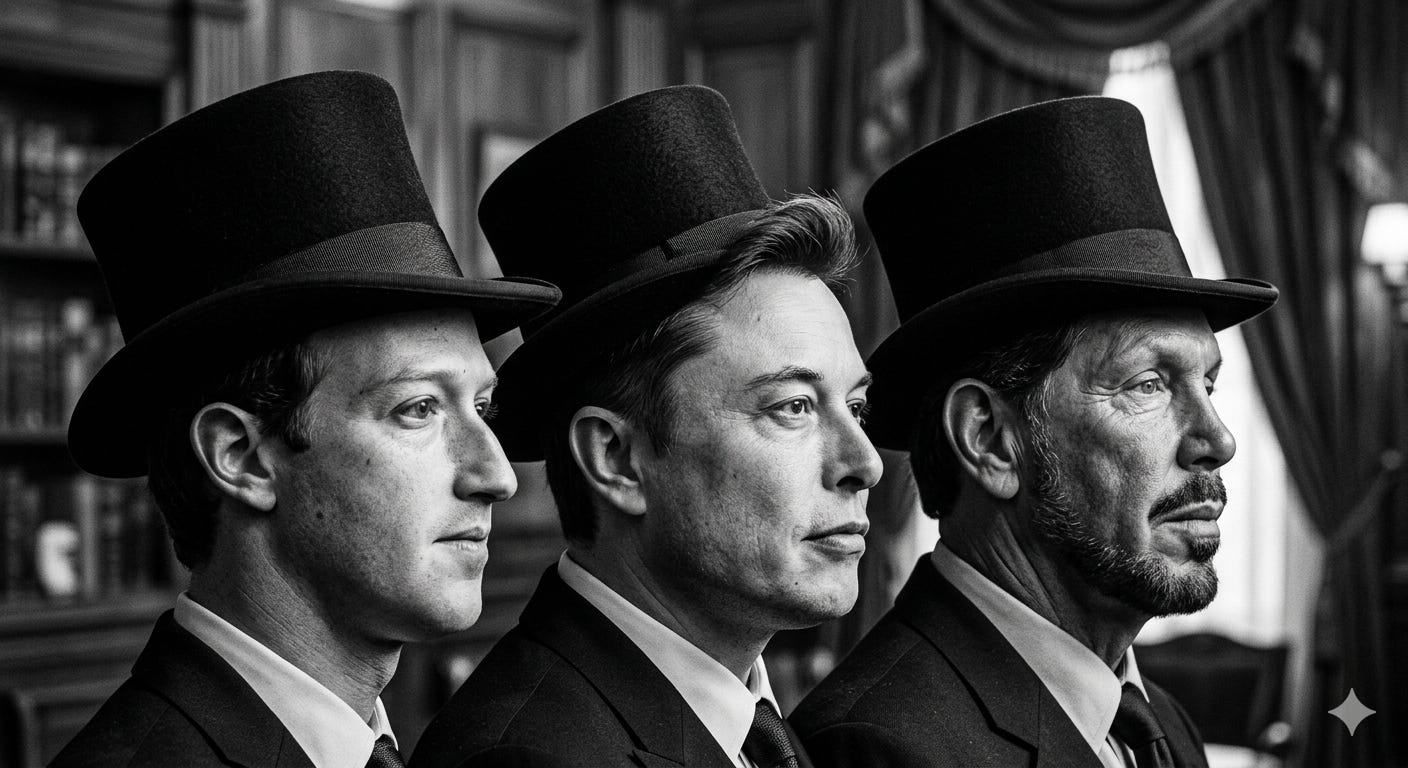
There was a time when Silicon Valley and the tech industry seemed — not cool, exactly, but vaguely countercultural and brashly anti-establishment. That was the point of Mark Zuckerberg wearing pajamas to an investor pitch, or tech execs spurning coats and ties: to emphasize that they were unlike traditional elites in every way. They consciously presented themselves as rebels whose products would liberate humanity from the old constraints of authority and tradition.
Back in the early 2000s, it would have seemed far-fetched to imagine that these former outsiders would become an elite themselves. But they now rank among the richest men in history, and in recent years it has become clear that they are translating this wealth into political influence and that the resources and technologies they command have the power to reshape all of our lives. Artificial intelligence, in particular, has reached a point where sane and rational observers are speculating that AI could substitute for human capital to the extent that labor’s share of national income could be reduced to near zero, or that AI companies might amass such a concentration of economic, political, and even military power that they could take over governments. We are therefore also at a moment when we are seeing some of the drawbacks that come with an elite that hasn’t thought much about how (or whether) it should take on the traditional responsibilities of elites toward their own society.
Alex Karp, the CEO of tech company Palantir, last month issued a manifesto that is in part a summons to his fellow Silicon Valley elites to recognize their public responsibilities. Karp calls upon his peers to take an active role in national security, deliver economic growth and security to the public, and defend the culture of the West. The manifesto is drawn from Karp’s 2025 book The Technological Republic, co-written with Palantir employee Nicholas Zamiska. Both the book and the manifesto have drawn harsh criticism from the political left, including the accusation that Karp seeks to bring about an AI-enabled technofascist dystopia.
But in many ways the more insightful critique of Karp has come from the right, most notably from Tanner Greer, a writer and analyst who produces reliably intriguing essays for his blog, Scholar’s Stage. Greer’s review of Karp’s book in the journal American Affairs ranges well beyond its nominal subject to argue that the “Eastern Establishment” — the industrialists, engineers, administrators, and politicians who drove the American Industrial Revolution between 1860 and 1930 — constituted a governing class worthy of emulation by today’s Silicon Valley elite. Greer’s second piece, a Scholar’s Stage post titled “35 Theses on the WASPs,” offers further suggestions for how “the upstart young of the ‘new right’” should think about the rise and decline of this bygone establishment.
Greer’s argument, in a nutshell, is that in the period between the Civil War and the Great Depression, the United States led the way in inventing and diffusing the critical technologies that enabled humanity to transition from the agrarian age to industrial modernity. The Civil War provided a powerful stimulus to American industrialization, and the victorious Union effort gave rise to a new governing class that joined leading industrialists, bankers, managers, engineers, and lawyers with traditional Northeastern political elites. This Eastern Establishment, working through the dominant Republican Party, enacted policies (including protective tariffs, favorable judicial treatment toward corporations, federal land grants to railroads, and the gold standard) that radically accelerated America’s technological development and brought about significant economic growth and improvements in Americans’ standard of living. The Eastern Establishment’s economic and political dominance also translated into social preeminence, partly because its founding members had the foresight to create national institutions (including schools, universities, and cultural organizations) that transmitted their class values to future generations.
This history is relevant to today’s tech elite, Greer continues, because Karp’s desire for a “union of the state and the software industry” is in effect a call for a new governing class. For such a class to be successful, in Greer’s view, it will have to reproduce the critical factors that distinguished the Gilded Age techno-nationalist elite: “a political coalition to which it owes allegiance and over which it exercises influence; an economic base that provides this class with wealth and unites its members around shared material interests; and finally, a set of institutions, rituals, and social customs that give this class a culture distinct from the country at large.”2 This combination of political, economic, and cultural power enabled the Eastern Establishment to lead and mold the country in line with its interests and ideals.
Will today’s Silicon Valley elite become that kind of techno-industrialist establishment? Greer believes they have “both the opportunity and the responsibility to shape American life for decades to come,” but that they have so far failed to leverage their wealth and influence to bring about the changes necessary to do so. They want a closer alignment between Silicon Valley and the state without being willing to commit to a coalitional political partner — presumably the Republican Party — or to use their economic and cultural power to bend the nation to their priorities. “You live below your privileges,” he admonishes the tech elite. “You must build the foundations of the world you want your children to inherit. You have the means and the minds to do this. Your problem is that you are not properly ambitious.”3
Greer’s American Affairs essay makes a forceful argument from history. It’s not one I agree with, but I feel strongly that any debate over Silicon Valley’s political role should take into account the historical contribution of American industry and elites to the country’s rise to global preeminence. I wish more people who make impassioned claims about this subject from both the left and the right would study the history of our nation’s corporate, managerial, and financial development as closely as Greer has.
Greer’s analysis of the Eastern Establishment offers real insight into the realities of power and influence in America in the 19th and 20th centuries, but that same analysis also complicates his argument in significant ways. Taking a page from E. Digby Baltzell — the sociologist who popularized the term WASP — Greer describes this establishment as the postwar fusion of a New England-centric patrician class with a rising group of industrial magnates.
People tend to use the term “establishment” to mean the rich, or the upper class, or the elite, or a set of powerful institutions. Paranoids use it as shorthand for the shadowy and faceless conspiracy that they believe pulls strings from behind the scenes. Baltzell, however, had a more precise meaning in mind. Every society has elites — people who occupy positions of power in critical sectors such as politics, business and the professions, the arts and sciences — and most societies have an upper class of families atop the social status hierarchy. But it’s not always the case that these two groups overlap to form an establishment.4
Every society has elites — people who occupy positions of power in critical sectors — and most societies have an upper class of families atop the social status hierarchy. But it’s not always the case that these two groups overlap to form an establishment
In America in the latter half of the 19th century, the upper class was represented by what philosopher George Santayana called “polite America”: the traditional Eastern seaboard aristocracy and its characteristic institutions like Yale and Harvard, which Santayana thought suffered from “inbreeding and anaemia.”5 A rising elite group, which Santayana called the “crude but vital America,” was led by self-made magnates from undistinguished origins. The “establishment,” in Baltzell’s terminology, was created when the new urbanized, industrial elite came together with the traditional upper class in the years after the Civil War. It was a process of mutual absorption. The old aristocracy opened its ranks to the talented outsiders, who in their turn funded the creation of new institutions — like the private boarding schools where they sent their sons to learn the moral code and traditions of public service that had given the upper class its legitimacy.
Baltzell believed that American society benefited from the creation of this establishment. In his view, the wealthy industrialists reinforced the power and standing of the upper class while also putting them in touch with the realities of a modernizing world. At the same time, the upper-class code of conduct operated as a check on the magnates who otherwise might destroy the republic through their greed and lust for power.
One of the most interesting aspects of Greer’s essay is his emphasis on the Civil War’s role in forging the new national establishment. The conflict brought together “disparate Northern regional elites, newly united beneath the Republican banner, and the rising class of industrialists and their financiers. The first seized the commanding heights of the Union’s politics; the second built the commanding heights of its economy. War bound them together in a common techno-nationalist project.”6
After the war, the victorious alliance of elites and industrialists pursued the vision of national integration that had long been thwarted by the South. Their alliance presided over industrialization and nation-building projects like opening the West to settlement, putting up telegraph lines, and building the transcontinental railroad. It was cemented by intermarriage between the two elite groups and the creation (or renovation) of characteristic establishment institutions of this period, including social clubs, summer resorts, Episcopal churches, Ivy League colleges, and the “St. Grottlesex” preparatory schools.
Greer emphasizes the role of these schools in socializing children who came of age without any experience of the Civil War that had been so formative for their fathers. Living arrangements at many of these schools were spartan, suggestive of the barracks and drill grounds. Students were expected to adhere to an austere and rather militaristic code of behavior, one that continued to govern their behavior in adult life. A major function of these schools, according to Greer, was to “cultivate the virtues the Civil War generation revered,” including not just patriotism and the martial values but also self-discipline, rationalism, and professional competence. The New England schools gave the children of a geographically dispersed elite “a shared background, a common set of expectations, and enduring social bonds,” which together with the other establishment institutions (including intermarriage) allowed it to “act with coherence and confidence long after the war had faded from living memory.”7
I find this interpretation plausible, with the caveat that most founders of the preparatory schools in the post-Civil War era were more directly influenced by the model of British institutions such Eton and Harrow. Similar claims about the enduring influence of the Civil War can be found in Ulysses Grant’s memoirs, in which the former Union general and U.S. president argued that the country was stronger for having endured the conflict: “We are better off now than we would have been without it and have made much more rapid progress than we otherwise should have made.” Grant further agreed that the war had given a major boost to U.S. industrial and military modernization.
Grant, however, emphasized: “Most important, Union forces had struck a major blow for freedom and equality.”8 Greer’s account, in my view, generally underestimates the importance of moral and egalitarian ideals (including the principle of racial equality) in the formation of the post-Civil War leadership. He believes that “The key city in [the Eastern Establishment] constellation was always New York City,” and that the scholarship of historians and sociologists like Baltzell “is distorted by its focus on elites in lesser Establishment cities such as Boston and Philadelphia.”9
But this is to dismiss the genuine struggle within the establishment, throughout much of the 19th and 20th centuries, between American commercial impulses embodied by New York and the ideals embodied by Boston. Conservatives who believe that politics is downstream from culture should consider how the post-Civil War histories written in Boston, for example, influenced Americans’ perceptions of national identity and national priorities. Historian Mark Peterson has demonstrated how the South’s defeat in the Civil War allowed Boston “to put its impress on the future of the United States,” not least by enabling Boston’s pioneering historians (including Francis Parkman, William Hickling Prescott, and John Lothrop Motley) to construct new narratives placing the WASP ideals of Boston and New England at the center of the nation’s rise to greatness.10
Greer faces an uphill battle in trying to reclaim the 19th-century “robber barons” as proper objects of imitation. One can respect the phenomenal growth and innovations produced by Gilded Age business and industry while recognizing the devastating costs that came with that era’s environmentally and socially destructive form of capitalism — and Americans’ determination not to accept this as the necessary price of progress.
There are obvious difficulties with comparing past and present industrial revolutions as well as elites. For starters, the present-day revolution in information technology so far has impacted a narrower sphere of human activity than its earlier equivalents. According to the economic historian Robert J. Gordon, the industrial developments stemming from the steam engine and its offshoots (including railroads and steamships), as well as those resulting from electricity and the internal combustion engine, “covered virtually the entire sphere of human wants and needs, including food, clothing, housing, transportation, entertainment, communication, information, health, medicine, and working conditions.”11 The IT revolution so far has been limited to the dimensions of information, communications, and entertainment — though it’s possible that AI could have a more transformative impact.
The net benefit of these innovations to national productivity and the average person’s standard of living also has been more mixed than those of the earlier revolutions. The innovations of the late 19th and early 20th centuries massively reduced infant mortality and lengthened overall life expectancy, for example. Many of the fruits of the tech revolution — particularly social media — have had a negative impact on our political stability and collective mental health.12 Earlier techno-industrial revolutions provided millions of blue-collar workers with a path into the middle class; Henry Ford’s gigantic company employed roughly three in 2,000 Americans in 1925 and paid them what at the time was a substantial minimum wage of $5 a day. The tech companies’ core workforces, by contrast, consist principally of small numbers of highly educated professionals — and meanwhile, AI threatens to make millions of white-collar jobs obsolete.
The benefit side of the ledger may well look brighter as the technological revolution continues. Meanwhile, however, many commentators have pointed to the ways in which some of the worst problems of American life in the 2020s resemble those of the late 19th century. Then as now, material well-being and unprecedented technological advances were accompanied by widening extremes of wealth and poverty, and an economy increasingly dominated by unaccountable corporate behemoths. That unchecked corporate power fueled destabilizing trends: cynical and divisive politicians rigging the system and shattering national unity, financial meltdowns, environmental devastation, massive immigration sparking a nativist backlash, riots and revolts, widespread social isolation and atomization, and a despairing sense among many Americans that their country had changed beyond recognition. The Gilded Age also marked the abandonment of Reconstruction and the efforts by Presidents Abraham Lincoln and Ulysses Grant to create a more racially inclusive democracy.
Americans pushed back against excessive corporate power almost as soon as they saw it taking shape; the Gilded Age industrial order did not exercise an unchallenged “70-year dominance of American business and government.”
While it would take nearly a century for the American political system to begin to live up to its ideals with regard to African-American citizens, Americans pushed back against excessive corporate power almost as soon as they saw it taking shape. The Gilded Age industrial order did not exercise an unchallenged “70-year dominance of American business and government,” as Greer suggests.13 The deficiencies of that order provoked major reform movements — first Populism, then Progressivism — along with a growing labor movement and even a robust Socialist Party.
And while many people believe the late 19th and early 20th centuries to have been a laissez-faire era, governments at all levels (including local and state as well as federal) took action not only to support economic growth but also to limit corporate excesses. Landmarks along this path included antitrust legislation and regulatory action, civil service reform, and the institution of progressive taxation as well as the creation of a rudimentary social welfare safety net. The Supreme Court affirmed the breakup of Standard Oil in 1911, and Congress created the Federal Reserve two years later in order to ensure the nation would not have to depend on the good graces of individual bankers to survive the next financial panic. Many of these initiatives were advanced by Republicans with the support of GOP presidents such as Theodore Roosevelt and William Howard Taft, which calls into question the idea of an all-encompassing political establishment.14
Greer’s depiction of a techno-industrial establishment implementing a “blueprint for modern America” in a deliberate and coordinated manner also seems to me to overstate the matter. Companies of that era competed viciously with each other and frequently failed to achieve consensus even within their organizations.[15] The company whose history I know best is the Corning Glass Works — still, as Corning Inc., the dominant manufacturer of specialty glass, including the glass in most smartphones. In researching its origins, I found that the company’s Gilded Age president, Amory Houghton Jr. (1837-1909), couldn’t even agree with his own sons about the need to hire academically trained scientists. When they urged him to hire a chemist, according to family lore, he allegedly responded: “I’ll have no damned college graduates working for this company.” He also refused to automate the lightbulb manufacturing process that would allow the Glass Works to keep up with larger competitors like Westinghouse and General Electric. In the end, Houghton’s sons went behind his back to recruit the scientists and develop the automation that kept the company solvent.16
As Greer recognizes, the story of the Eastern Establishment unfolded across a span of generations and decades. The continuities between generations are significant, but so too are the discontinuities. Amory Houghton Jr. once lost control of his company to his creditors and lived in constant fear of debt; he told his son that every day he went to work felt like walking along the edge of a cliff. Like Houghton, the corporate founders of the first generation tended to be obsessively focused on securing the bottom line and establishing mastery over their particular fiefdoms. It tended to be the next generations that had the breathing room to consider the wider national and international picture.
Amory Houghton Jr.’s son Alanson (1863-1941) is a case in point. Amory Jr. had only a high school education. Alanson graduated from the St. Paul’s School, where his classmates included John Jacob Astor Jr., William Randolph Hearst, and the two sons of U.S. President James Garfield. He went on to Harvard, where he internalized the college’s Puritan-derived system of manners and values. He also pursued graduate studies in Göttingen, Berlin, and Paris, often alongside his friend and Harvard classmate George Santayana. He returned to the States to take up leadership of his family’s glass company, which he tripled in size before becoming a member of the U.S. House of Representatives and ambassador to Germany and Great Britain.
It would be difficult to make the case that Amory Houghton Jr. belonged to (or took his cues from) a national and associational upper class. His son Alanson, however, was a quintessential Eastern Establishment type, from his corporate and political connections to his baronial mansion and his membership in elite social clubs such as the Jekyll Island Club, where he wintered with Morgans, Rockefellers, and Vanderbilts. But as a participant in a national and associational establishment, Alanson Houghton also moved away from the politics and mentality of founder magnates like his father. In politics a progressive Republican, he believed in social reform measures (such as women’s suffrage), expanded foreign trade, and international engagement. He tried to cool the nativist passions that flared up with the Red Scare that followed the Great War, insisting that even radical criticism of the government should be permitted so long as the changes sought were pursued through constitutional means. He also was a founding member of the Board of Trustees of the Institute for Advanced Studies, serving as chairman when Albert Einstein and other refugee scholars arrived there in the early 1930s.17
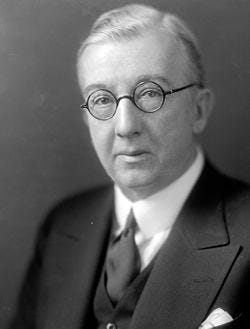
Nor was the rule of this successor generation as short-lived as Greer’s account might lead readers to believe. In Greer’s telling, the Great Depression “ruined a great many Eastern Establishment families” and led to the New Deal, which was “an explicit attempt to downgrade the political, economic, and cultural influence of Eastern elites.” He suggests that the rise of “the national scientific complex” — including the Manhattan Project, World War II industrial developments, and the rise of the Cold War national-security state — posed “a fundamental challenge to older Establishment institutions and cultural authority.”18 By the late 1950s, according to Greer, the Eastern Establishment had been defunded, disempowered, and displaced in the cultural sphere by the prestige of brilliant scientists (including many émigrés) as well as rival forces like Hollywood.
But the example of Alanson Houghton and the Institute for Advanced Studies highlights that the establishment was present on all sides of this conflict, if it can even be called a conflict. The Rockefeller Foundation funded the Emergency Committee in Aid of Displaced Foreign Scholars, which helped bring to this country a constellation of brilliant scientists and scholars that included Einstein, Enrico Fermi, Leo Szilard, and much of the Frankfurt School. Establishment figures like James Conant, Vannevar Bush, and Harvey Bundy were critical to establishing the postwar framework for government funding of science and technology. Henry Stimson, the quintessential establishment paladin, served as Secretary of War under Democratic presidents Roosevelt and Truman, after having served in the same position under Republican President William Howard Taft as well as Secretary of State under Herbert Hoover. And while midcentury Hollywood was culturally a world away from the WASPy Northeast, it’s worth remembering how many actors of that era Anglicized their names or adopted a manufactured WASP persona. It’s also notable that establishment fixture John Hay Whitney financed Gone with the Wind along with a raft of other classic films. In fact, it was not until the 1950s that Americans even began to use the term “establishment” in a sociopolitical sense, and they most certainly believed that it referred to an existing elite and ongoing power realities, not just the country’s history between 1870 and 1930.
There is no doubt that the Depression did discredit the Republican Party and many of the policies it had upheld since the 19th century, which the considerable majority of Americans came to believe had brought on the economic collapse and which offered few solutions for the widespread misery that resulted. Some Old Guard Republicans continued to cling to Gilded Age nostrums. But the party as a whole moved toward moderation during Dwight Eisenhower’s presidency, endorsing parts of the New Deal social welfare safety net as well as policies to educate and empower the workforce — and the result from 1940 to 1970 was both a much faster rate of growth (measured in output per person) and a more egalitarian and cohesive society than in the period from 1870 to 1940.19
The Eastern Establishment pivoted in response to the Depression, away from knee-jerk association with the GOP and toward the model of Henry Stimson and his acolytes, who offered dedicated public service to both Republican and Democratic administrations as an expression of placing the interests of nation above class. Although many today would dismiss this idea of noblesse oblige as a myth, it was reinforced by the high rate of World War II casualties among graduates of elite prep schools and universities as well as the service of dollar-a-year men in government and the wholesale conversion of American industry to wartime production. The postwar era also saw the movement toward meritocracy in Ivy League universities under leaders like Harvard’s James Conant and Yale’s Kingman Brewster Jr., largely because they believed that elite institutions had national responsibilities that transcended the interests of the class into which they had been born.
In pursuing meritocracy to its logical and moral conclusion, midcentury Ivy League leaders showed their fidelity to the establishment’s core principles.
Some elites of the earlier era, of course, had argued for taking the opposite course: that is, for placing the perceived interests of their class above those of the nation. One of the bestselling authors of the 1920s and ‘30s was Lothrop Stoddard (1883-1950), a leading American proponent of eugenics in the decades before World War II and author of works such as The Rising Tide of Color Against White World Supremacy and The Revolt Against Civilization: The Menace of the Under-Man. Unsurprisingly, the National Socialist regime in Germany hailed Stoddard as a prophet, and race theorist Alfred Rosenberg incorporated Stoddard’s term “under-man” into Nazi ideology.
Stoddard, who received his undergraduate and Ph.D. degrees from Harvard, was not merely a white supremacist but also a class supremacist. He insisted that the WASP establishment could retain its primacy only through the suppression of “inferior” races and classes, meaning essentially all Americans who did not belong to the Anglo-Saxon elite. He presented this as a program of progressive reform, but added that “our social ills are largely the product of degeneracy,” and that “degeneracy can be eliminated only by eliminating the degenerate. And this is a racial, not a social matter.”20 He looked forward to the day when unruly American democracy would be replaced by a “Neo-Aristocracy” of racially superior patricians and technocrats.
Stoddard’s program was rendered tragically concrete in the forced sterilization of tens of thousands of Americans for reasons of racial unfitness from the 1920s through the 1940s. It also manifested in the Johnson-Reed Act of 1924, explicitly eugenicist legislation that drew upon Stoddard’s work along with that of the Boston Brahmin-dominated Immigration Restriction League. Much of the early 20th-century elite was taken in by eugenic pseudo-science to a degree that seems shocking now; Stoddard engaged in friendly correspondence with U.S. presidents and senators, and he and his associates came close to persuading major universities to set up eugenics studies departments.21
Eugenics, with its privileging of race and class over the nation, stood in stark contradiction to the principles of meritocracy, equality of opportunity, and disinterested public service that were at the heart of the founding creed of the Eastern Establishment. Of course the members of the establishment frequently honored this creed more in the breach than the observance; Baltzell’s most famous work, his 1964 The Protestant Establishment, lamented that the establishment, by failing to assimilate talented people from non-Protestant ancestry, was becoming a caste and was thereby squandering its legitimacy.22 For all the talk of elite university leaders like Harvard’s Conant and Yale’s Brewster being “traitors to their class” — talk that is seeing an ugly revival in our present day — in pursuing meritocracy to its logical and moral conclusion they showed their fidelity to the establishment’s core principles.
So what lessons should today’s tech titans take from this history? We have yet to see whether this small group of billionaires (and soon perhaps trillionaires) will act as a group, or what coordinated use they might make of their immense power outside of the commercial realm. But, equally or more importantly, we have yet to see how (or whether) the American public and the political system will seek to rein in or channel these elites along with the technologies they command.
Anthropic CEO Dario Amodei has been a strong advocate for the civilizational benefits AI will confer upon humanity in the long run, but he also worries about anti-AI backlash in the short run. His January 2026 essay “The Adolescence of Technology” points out that Elon Musk’s wealth, as a percentage of U.S. GDP, already exceeds that of John D. Rockefeller, the wealthiest industrialist of the Gilded Age. And since Amodei believes that extreme wealth concentration combined with large-scale job losses have the potential to “break society,” he calls for the world’s billionaires to support high levels of progressive taxation. As he puts it, either they can accept the pragmatic argument that it’s in their interest to support a good version of such taxation, or else “they’ll inevitably get a bad version designed by a mob.”
Amodei also notes that “even in the Gilded Age, industrialists such as Rockefeller and Carnegie felt a strong obligation to society at large, a feeling that society had contributed enormously to their success and they needed to give back.” He laments that such a spirit “seems to be increasingly missing today,” particularly among the “many wealthy individuals (especially in the tech industry) [who] have recently adopted a cynical and negative attitude that philanthropy is inevitably fraudulent or useless.” He argues that “Those who are at the forefront of AI’s economic boom should be willing to give away both their wealth and their power.”
Amodei’s worries overlap with Greer’s concern that the tech elite currently bears a close resemblance to the wealthiest groups of the antebellum era, whom Greer described as “suspicious of executive power, distrustful of American nationalism, insulated from the American public,” and seeking the highest return on their investments “regardless of the political consequences for doing so.”23 Greer recently said on a podcast that “There’s some people in Silicon Valley who have a tactical alliance with Trump world, but there’s not a sense that ‘Oh, we need to take special political care of these parts of the country because they’re part of our coalition, and only if we have a political coalition in charge are we going to make sure that we have energy being sent to our data centers’ or what have you. That sort of consciousness is very rare in Silicon Valley.” It’s a sharp contrast, in Greer’s telling, with the Eastern Establishment’s Republican elites of the late 19th century, who kept Midwesterners in the coalition by backing tariffs to protect wool manufacturers while also shoring up base support through federal spending on Civil War veterans’ pensions.24
But is Donald Trump’s Republican Party the appropriate coalition partner for a techno-industrialist elite? It’s true that the administration until recently had done little to interfere with the tech giants, particularly in AI, partly out of conviction that regulation would allow the Chinese to gain the advantage. Greer, as a full-time researcher on the Chinese Communist Party, has written persuasively on how the United States is engaged in an increasingly adversarial competition with China that resembles the Cold War with the Soviet Union. Greer and coauthor Nancy Yu, writing in Foreign Policy, emphasize that the Chinese government’s primary strategic goal is “to build an industrial and scientific system capable of pushing humanity to new technological frontiers.” The Chinese leadership, in their view, believes human history is at a hinge point in which emerging technologies can topple existing economic and political orders, much as the British Empire and the post-World War II United States “rose to global hegemony by pioneering a global techno-economic revolution.”25
But the administration’s hands-off approach appears to be changing, as AI poses a growing threat to Americans’ job opportunities as well as to national security.26 For example, the Pentagon has attempted to punish Anthropic because CEO Amodei refuses to allow the company’s model to be used in fully autonomous weapons or for mass domestic surveillance.27 More crucially, however, at no point has the administration attempted to mount a serious and sustained revival of the state capacity that would allow us to restore the American manufacturing and scientific-technical prowess needed to compete with China. On the contrary, it has engaged in pointless acts of national self-harm, including its cutbacks to university research as well as government scientific and funding agencies.
The most obvious model for how the United States might compete in and win a new cold war is how we won the last one — and that model is more Eisenhower than Trump.
This should give our would-be tech establishment pause, as the most obvious model for how the United States might compete in and win a new cold war is how we won the last one. In October 1957, after the launch of Sputnik raised the terrifying possibility that the U.S. had fallen behind the Soviets in critical space and military technology, an organization of business officials (called the Committee on Economic Development, or CED) held a high-level meeting with government officials. According to sociologist Mark Mizruchi, the CED then produced a series of reports “on the need for increased government efficiency, coordination of defense expenditures, economic performance, and a massive upgrading of American education, all of which the group saw as essential to fighting the Cold War with the Soviets.”28 Within a year, thanks in part to the support provided by these business elites, Congress had passed a sixfold increase in federal funding to education compared to the start of the decade. President Dwight Eisenhower shortly thereafter signed the bill that created NASA, then established the Advanced Research Projects Agency that went on to create (in whole or in part) many of the breakthrough technologies that we now rely upon (including the Internet). Over the next decade, federal funding for scientific research increased tenfold.29
Eisenhower understood that science and technology had been essential to victory in World War II and that Cold War success would require unprecedented collaboration between government, universities, and industry. He bolstered the bureaucratic capacity for high-quality policy work that, as he knew better than anyone, had been a critical deficiency of the German and Japanese high commands.30 And he relied upon our allies as force multipliers and invested in critical infrastructure projects including the creation of the national highway network.
By the time of Eisenhower’s presidency, the corporate elite included many of the grandchildren of the Civil War generation of industrial magnates. As a group, they had been chastened by the failures that had led to the Depression, had come to a grudging acceptance of at least some degree of higher taxation and federal regulation, and had been inspired by their partnership with government in World War II.
Unfortunately, there is scant evidence so far that today’s tech elite is evolving toward a similar kind of responsible national leadership. The Republican Party under Donald Trump has neither the interest nor the capacity to impose limits on the tech elite to better serve the national interest, and it’s not clear what other group or groups in society might serve as that countervailing force. Meanwhile, the case studies in tech hubris are too numerous to mention; lowlights include Sam Bankman-Fried’s use of “effective altruism” as cover for financial recklessness, Apple’s global tax evasion scheme, and Elon Musk’s feckless and destructive DOGE initiative.
This elite has so far made little use of its massive wealth to restore American productivity and dynamism, whether through reforming our dysfunctional politics, reviving the left-behind areas of our country, improving our rotten educational system, elevating our decadent culture, or mounting a Gates Foundation-type effort to save lives in this country as well as abroad. It has done next to nothing to push back against the administration’s sabotage of state capacity or its efforts to undercut America’s ability to attract talent from all around the world, without which Silicon Valley would be a shadow of itself. Nor has it stood up to safeguard the freedoms of thought and expression that allowed America to become the world’s leading scientific and technological power in the first place.
To the contrary, there is an obvious pro-MAGA tilt to defense tech — on full display at the recent Hill and Valley Forum in Washington.31 Such partisan dalliances only make it likelier that Democrats will take harsh actions against leading Silicon Valley firms when they regain power. My personal opinion is that breaking up companies at the tech vanguard would be a mistake, since history suggests that, like it or not, a handful of massively scaled and massively funded companies are essential to achieving technological breakthroughs and spreading new technologies to the mass market — and the consequences of China winning the AI race would be decidedly negative for America and much of the world.32 The better outcome would be for the tech sector, like the post-World War II establishment, to aim to be above partisanship. Alignment with any party in a polarized democracy puts the sector’s public legitimacy at risk; a national strategic asset shouldn’t be a factional weapon.
A more laudable example of Silicon Valley leadership, suggesting the nonpartisan path the tech elite should follow, comes from the 2024 book Unit X by Raj Shah and Christopher Kirchhoff. It describes how the authors founded the Defense Innovation Unit Experimental — DIUx, or Unit X for short — in an attempt to bridge the gap between Silicon Valley and the Pentagon. Silicon Valley teams, working with nimble units within the government across multiple administrations, bypassed the Pentagon’s change-resistant bureaucracy. They used agile, iterative methodologies to outcompete the big defense contracting companies in a fraction of the time for a fraction of the cost.
Tanner Greer is correct that the Eastern Establishment played an outsized role in American history over a decades-long span because it aligned industrial wealth, political power, and a culture sustained by upper-class rituals and institutions. But what made the establishment durable — and indeed gave it legitimacy — was less lockstep agreement on political issues than an ethos that subordinated class interest to national interest. At its heart was a compromise that involved not just the negotiated mutual absorption of two rival groups but their adjustment to a higher national creed. The New England aristocracy allowed the “crude but vital America” into its ranks, while the industrialists agreed to Puritan-inspired limits on their pursuit of profit at all costs. The establishment that emerged did, at its best, prove willing to incorporate talented outsiders, to adhere to an ethos of disinterested public service, to abide by norms of liberal democracy, and to build institutions that ultimately undermined its own dominance — even while helping to make the United States the most globally competitive society the world had ever seen.
If America’s power centers can reach a similar equilibrium, we may see a new and nationally responsible establishment take shape. If they don’t, the future holds little but destruction — and not the creative kind.
Geoff Kabaservice is Vice President of Political Studies at the Niskanen Center and the author of The Guardians: Kingman Brewster, His Circle, and the Rise of the Liberal Establishment and Rule and Ruin: The Downfall of Moderation and the Destruction of the Republican Party, From Eisenhower to the Tea Party. He hosts the podcast “The Vital Center.”
[1] Philip Trammell and Dwarkesh Patel, “Capital in the 22nd Century,” Philip Trammell (Substack), Dec. 29, 2025.

Noah Smith, “What if a few AI companies end up with all the money and power?,” Noahpinion (Substack), Apr. 12, 2026.

[2] Tanner Greer, “The Making of a Techno-Nationalist Elite,” American Affairs IX:4 (Winter 2025). https://americanaffairsjournal.org/2025/11/the-making-of-a-techno-nationalist-elite/
[3] Tanner Greer, “35 Theses on the WASPs,” Scholar’s Stage, Jan. 12, 2026. https://scholars-stage.org/35-theses-on-the-wasps/
[4] Aaron M. Renn, “Rediscovering E. Digby Baltzell’s Sociology of Elites,” American Affairs V:1 (Spring 2021).
[5] George Santayana, The Genteel Tradition at Bay (New York: Scribner’s, 1931).
[6] Greer, “The Making of a Techno-Nationalist Elite.”
[7] Ibid.
[8] Quoted in Ron Chernow, Grant (New York: Penguin, 2017), p. 518.
[9] Greer, “35 Theses on the WASPs.”
[10] Mark Peterson, The City-State of Boston: The Rise and Fall of an Atlantic Power 1630-1865 (Princeton, NJ: Princeton University Press, 2019), p. 624.
[11] Robert J. Gordon, The Rise and Fall of American Growth: The U.S. Standard of Living Since the Civil War (Princeton, NJ: Princeton University Press, 2016), p. 320.
[12] See for example Martin Gurri, The Revolt of the Public and the Crisis of Authority in the New Millennium (San Francisco, CA: Stripe, 2018) and Jonathan Haidt, The Anxious Generation: How the Great Rewiring of Childhood is Causing an Epidemic of Mental Illness (New York: Penguin, 2024).
[13] Ibid.
[14] So too does the history of factional warfare within the Republican Party during this era, including strife between Stalwarts and Half-Breeds and Mugwumps as well as TR’s breakaway Bull Moose Party.
[15] Greer, “The Making of a Techno-Nationalist Elite.”
[16] Amo Houghton Jr., unpublished memoir; see also Davis Dyer and Daniel Gross, The Generations of Corning: The Life and Times of a Global Corporation (New York: Oxford University Press, 2001).
[17] Jeffrey J. Matthews, Alanson B. Houghton: Ambassador of the New Era (Lanham, MD: Rowman & Littlefield, 2004).
[18] Greer, “35 Theses on the WASPs.”
[19] Gordon, p. 319; Robert D. Putnam and Shaylyn Romney Garrett, The Upswing: How America Came Together a Century Ago and How We Can Do It Again (New York: Simon & Schuster, 2020), p. 10.
[20] Lothrop Stoddard, The Revolt Against Civilization: The Menace of the Under-Man (London: Chapman & Hall, 1922), p. 227.
[21] James Robert Bachman, “Theodore Lothrop Stoddard: The Bio-Sociological Battle for Civilization,” Ph.D. dissertation (University of Rochester), 1967.
[22] E. Digby Baltzell, The Protestant Establishment: Aristocracy & Caste in America (New Haven, CT: Yale University Press, 1964).
[23] Greer, “The Making of a Techno-Nationalist Elite.”
[24] “From WASP Elites to AI Kings,” Tanner Greer interview with Aaron Renn, The Aaron Renn Show, Jan. 19, 2026.
[25] Tanner Greer and Nancy Yu, “Xi Believes China Can Win a Scientific Revolution,” Foreign Policy, Apr. 30, 2024.
[26] “America wakes up to AI’s dangerous power,” Economist, Apr. 16, 2026. https://www.economist.com/leaders/2026/04/16/america-wakes-up-to-ais-dangerous-power
[27] Julian E. Barnes and Sheera Frenkel, “Anthropic Says It Cannot ‘Accede’ to Pentagon in Talks Over A.I.,” New York Times, Feb. 26, 2026. https://www.nytimes.com/2026/02/26/technology/anthropic-pentagon-talks-ai.html
[28] Mark Mizruchi, The Fracturing of the American Corporate Elite (Cambridge, MA: Harvard University Press, 2013).
[29] Geoffrey Kabaservice, “The Effective Conservative Governance of Dwight Eisenhower,” The American Conservative, Oct. 15, 2022.
[30] Paul Kennedy, Engineers of Victory: The Problem Solvers Who Turned the Tide in the Second World War (New York: Allen Lane, 2013).
[31] Elizabeth Dwoskin, “Welcome to the war party: The new Trump-tech alliance cashes in,” Washington Post, Apr. 1, 2026. https://www.washingtonpost.com/technology/2026/04/01/silicon-valley-defense-spending-hill-valley-forum/
[32] Michael Lind, “Why the US economy beats Europe,” UnHerd, Apr. 18, 2026. https://unherd.com/2026/04/why-the-us-economy-beats-europe/?edition=us
 | A guest post by
|
I like Leon Liao's summary: "A technological republic cannot be built only through defense contracts, AI systems, patriotic rhetoric, or an alliance with one political faction." I just don't see today's tech elite moving beyond that. I think they are still characterized by a combination of countercultural oppositional attitudes, a libertarian preference for exit over voice, and a technocratic mindset that privileges technological revolution over social/political reforms. (The DOGE fiasco is a classic example of the latter: the idea that a few smart guys with an LLM could "refactor" the Federal bureaucracy on an accelerated timescale.) To the extent they get involved in national affairs, I predict it will primarily be as government contractors and political donors operating on a purely transactional basis ("Here's what I can do for you. What's in it for me?"), and they will tend to favor politicians and administrations that take that same approach.
All of the various conflicts and disparities among the various members and factions of the WASP elite during their heyday took place against a background of a taken-for-granted shared identity: the elite were white, English-speaking Protestants, and American identity was defined in terms of being a white, English-speaking Protestant country. All that egalitarian social flourishing in the 1940s and 1950s had the required preconditions of both extreme immigration restriction, and huge social pressure towards assimilation. All the conflicts from Union/Confederate to FDR/WASP took place within what, from the broader perspective of human culture and history, constituted one small subunit of the human family, taking for granted most of the basics of culture and morality. That's why the American people could accept that the elite had some baseline level of legitimacy - on some level, "they're 'us.'" The same intuitions and sentiments motivated every anti-colonial revolt in the modern era: people want to be ruled by "us" rather than by a foreign tribe. How on earth any of this concern for the national interest is supposed to take place under conditions of Diversity and Multiculturalism is, to say the least, an open question. At an absolute minimum, it would require Americans of all backgrounds to be able to share a basic patriotism and reverence for the idea of America. Unfortunately, the idea that the elite should prioritize a concern for the American nation, over against the other several billion people in the world, is widely considered déclassé and icky and Trumpy. A sign that things are moving in the right direction would be if American flags were more popular than say, Mexican or Palestinian flags, at various anti-Trump demonstrations. Don't think that's going to happen any time soon.