


Call it the information age, the fourth industrial revolution, the cognitive era. Call it whatever you like, but it seems clear we are in the midst of an economic transformation as profound as those that sent medieval serfs to the cities, yeoman farmers to conquer the Western frontier, huddled masses to the United States.
The birth of industrial capitalism in America’s Gilded Age created the outlines of our political, economic, and social order, from the modern presidency to the eight-hour day to the unionized family wage. Facing mass immigration into overflowing cities, dirty and dangerous factory work amid machines of unfathomable power, and behemoth corporations that fundamentally changed the dynamics of economic competition, Americans of the late 19th and early 20th centuries banded together in myriad political and social movements attempting to tame the beast, from settlement houses to temperance movements to Theodore Roosevelt’s Bull Moose Party. Whatever their excesses and flaws, these movements preserved capitalism’s essential core of creative destruction while drawing a protective membrane around the social fabric that it threatened.
Today, the transformations of capitalism work on our minds, not our bodies. Their power is no less profound, from the acceleration of polarization to the youth mental health crisis to the usurpation of our basic cognitive processes by AI. Yet there has been a strange passivity in the reaction. Nobody likes social media, but nobody logs off. Suggestions of regulation, restriction, or modification are met with shrugs. We are told technology’s dominance of our private lives, families, and workplaces is inevitable. Everyone else is doing it, and there is no way out. Why this pervasive sense of powerlessness? Digital media is acting on our politics in obvious ways, but our politics don’t seem to be acting much on digital media. What will it take to rouse a coordinated reaction—or has one perhaps just gotten started?
When reflecting on the social response to Gilded Age capitalism, it’s important to remember how long change took, and the many channels through which it flowed. The last era of capitalist reform stretched for roughly 60 years, from the 1869 completion of the transcontinental railroad, which supercharged economic growth, to the end of the 1930s, when Franklin Roosevelt’s New Deal codified in federal legislation worksite policies first pioneered on the state level. What makes it into the history books is landmark legislation and constitutional change. But these six decades brought a variety of interlocking responses responding to the ripple effects of industrial change in society and culture. Courts had to work out just who was responsible when a railroad took life or limb. Temperance crusaders had to coax women out of the home and into public life to agitate against the saloon, that great destroyer of families. Workers were shot and killed with regularity along the path to safe working conditions, from the Homestead Strike of 1892 to the 1932 Ford Hunger March. Varieties of unionism rose and collapsed. College-educated elites conducted studies, ran for office, and exposed corruption. Urban bosses organized immigrant voters and constructed patronage systems that doubled as a proto-welfare state.
Critically, as industrialization proceeded, its booms and busts began to create common cause between American farmers, urban immigrant workers, and their champions in the professional class. The central dividing line of mass politics — tariffs — had long split agrarian communities from manufacturing towns. But now both found they needed something new from politics. It’s as if today the rise of artificial intelligence threw blue and red states together into a new order that erased the diploma divide. Back then, it took crisis upon crisis, campaign upon campaign, until a new syntax of politics emerged in books like Herbert Croly’s Promise of American Life and Walter Lippmann’s Public Opinion, which both called for a new politics to meet a new era, providing a vital rallying call for political leadership.
The tariff debate that divided rural and urban Americans was transcended, as if today the rise of artificial intelligence threw blue and red states together into a new order that erased the diploma divide.
It’s also important to remember how overwhelming this change was to those who lived through it. Railroads cut time and space to ribbons. At one time in our history, the vast majority of Americans were used to moving no faster than their feet could carry them — or at the speed of a horse, if they were lucky. It must have been profoundly disorienting — albeit thrilling — to watch the landscape blur through a train travelling in hours a distance that once took days. Standing before the belching iron horse, what American could believe they had the power to impact this stupendous triumph of technology, this iron god? Likewise, today it seems impossible to imagine that digital technologies could be reshaped by political or social pressure, given their ubiquity, their usefulness, their addictive qualities. The problem seems even more intractable given how digital mediums have become indispensable to the cultivation and maintenance of political power. If the changes digital technology has wrought are less tangibly obvious than the railroad, the steamship, the industrial factory, or the automobile, they are no less overwhelming when taken together.
Yet it is possible to glimpse the emerging contours of a comparable politics, starting with the stirring of diffuse social movements and reactions. Someday, we might look back to Jonathan Haidt’s The Anxious Generation and place it in the same category as Upton Sinclair’s The Jungle, the expose which forever changed American factories. The movement to ban phones in schools is one of the first organic social responses to the new world we have entered. From silent book clubs to the Reconnect movement on college campuses to the consortium of authors that sued Anthropic, the signs of resistance are everywhere. This transformation in culture is essential. Before the tobacco litigation of the 1990s, for example, came a widespread recognition that smoking was harmful, and a decline in social acceptance.
Slowly but surely, Americans are recognizing the naivete of our first gee-whiz reaction to the internet, which was imagined by both political parties as a new zone of freedom and celebrated with inane slogans like “information wants to be free.” But the problem is our laws and norms date from that era. The time has come for a rethinking based on what we now know — that data wants to be expensive, cyber surveillance is unavoidable, and the hours spent on social media have wreaked havoc in the real world.
Until the shooting of Charlie Kirk, there was no national political figure willing to take on this cause. But when the national spotlight swung to Utah Governor Spencer Cox, Americans heard the first serious case against social media from a political leader — one driven by tragedy, but that nonetheless offered a studied reflection on what technology has wrought. “‘Cancer’ probably isn’t a strong enough word,” Cox declared in the aftermath of Kirk’s death, going on to call social media algorithms “evil.” This religiously inflected language may sound jarring at first. But the passion it channels is exactly what powers effective political movements. Cox too has a target in mind: “these companies with their trillion dollar market caps … They’re hijacking our free will with these dopamine hits, same chemical reaction as fentanyl.” It’s a populist take that mirrors the diagnosis once aimed at the beef trust and Standard Oil.
What would a politics that squarely confronts the change wrought by the fourth industrial revolution look like? It might look like the Utah legislation that Cox championed, requiring robust age verification, that has been stalled by lawsuits. Cox’s reference to fentanyl suggests it could look like the opiod lawsuits, and indeed suits against social media and AI platforms for a range of harms are wending their way through the courts. It could look like legislation to make public the algorithms that shape platforms, or a requirement that makes consumers the owners of their data. National security concerns around TikTok suggest another dimension to the problem — both the recognition that adversaries are actively using these platforms to sow internal dissent, and the powerful forces that resisted legislation.
Charlie Kirk’s shooting may accelerate the politics of reform. Until recently, there has been little incentive for political elites to rein in digital media. Like Kirk, after all, many owe their careers to its successful use. But political violence — and the widening of targets beyond national-level politicians to state-level leaders, organizers, and activists — may change the calculus dramatically.
The tech companies have an edge — they control much of what we see, feel, and think. But the farmer who needed to pay exorbitant rates to the railroad seemed powerless too. So did the recent immigrant with nothing to offer but their labor. What made them strong was a shared sense of purpose, legitimate grievance, and political leaders willing to respond. The last time around, it took nearly half a century to marshal the social, political, and legislative forces to meaningfully alter the fallout from industrialization. Today, technology itself has sped up the clock, so it might be later than we think. But if capitalist upheavals are coming faster than ever before, maybe so can the response.
Jennifer Burns is Edgar E. Robinson Professor of United States History at Stanford University and a research fellow at the Hoover Institution. She is the author of Goddess of the Market: Ayn Rand and the American Right and Milton Friedman: The Last Conservative.
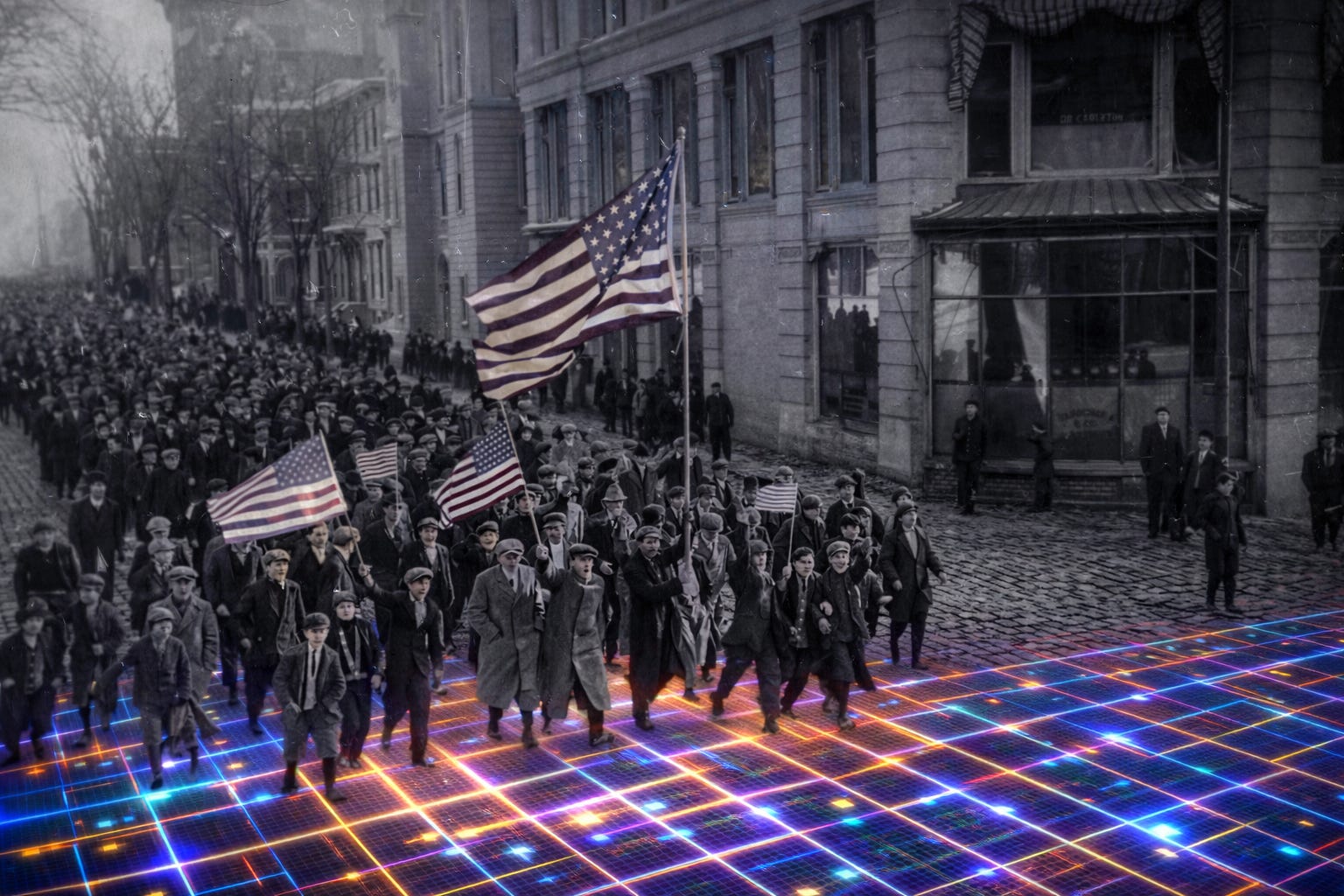
Image: Lawrence strike, 1912 , Digital Public Library of America. Modified with ChatGPT.
 | A guest post by
|