

Build-your-own workforce, the federal way
AI will require more employers to build their own workforce pipelines. For lessons, they can look to federal agencies including the CIA and CDC.

For decades, many employers and industries outsourced the development of their early career workforce to universities and to the first-job-elsewhere model. Bright graduates could get a bit of seasoning at a consulting firm, a bank analyst program, or on the Big Law associate track, and then be ready for other employers to snatch up. For these firms, this was a good deal: they got high-quality labor for entry-level positions and some alumni end up being clients and customers for this work in the future after they move on.
But the entry-level tasks that those professional firms needed to dump onto recent grads is precisely the work AI is automating away first. I took notes during my first two years in the workforce as a management consultant. We need not speculate what will happen to that work; it is gone today.
This is not only a problem for the grads who will not find that first job. It is just as much a problem for employers whose talent pipeline is at risk of collapse.
Predictably, a large crowd is gathering around this (potential) early-career sinkhole to speculate how large it will get and offer potential solutions. So far, many of these ideas are old standards that have a “now more than ever” quality to them; each also has practical implications that may make it difficult to enact legislatively or to implement. The white-collar registered apprenticeships advocated by Monica Prasad share, in some ways, the same challenges as college degrees – if the credential you signed up for at the beginning isn’t relevant by the end, you’ll wind up lapped by the economy. National Service is a good idea that I support, but it has persistently failed to gain traction despite big supporters like General Stanley McChrystal and others. And so on with Universal Basic Income, various forms of novel taxation, and the rest.
I will argue for a model that is duller, but whose shape we do not need to guess at: Employers simply need to begin to see it as their job to bridge the gap between education and usefulness for early career talent. In other words, many more American companies must build and operate their own pipelines, each understanding its pipeline as the only or at least the primary mechanism by which it will fill jobs in the future.
And indeed, we actually already know what this might look like at scale, because the federal government does it every day.
Also in this forum:
We know how to prepare for the AI shock, by Monica Prasad
We must diversify our workforce bets, by Will Raderman
Universal Basic Salary: Help employers train workers. Drop failed programs, by Monica Prasad
There is no major for spies
When Ford needs a new automotive engineer, it can hire from a relatively robust talent marketplace – it has competitors that also make cars, suppliers that produce many of the components, near-peers in other industries that design other complex manufactured goods. All employ competent engineers who might be good sources of talent. This is true across most of the economy in both the public and private sector: City managers often move from city to city on something of a career ladder. The federal acquisition workforce rotates relatively often among agencies. And nursing is one of the highest-attrition professions in the country as professionals routinely swap workplaces in a competitive marketplace.
When the CIA or its peers in the intelligence community need to hire officers and analysts, they have no such luck: not a lot of places to poach from. No university grants a degree in clandestine HUMINT gathering or counterintelligence tradecraft, and the handful of programs that try — intelligence studies, counterterrorism studies, international affairs — produce useful raw inputs but not finished intelligence officers. To consume talent, they first need to make it.
Which means the IC has to do something the rest of the government almost never does: hire before the need arises rather than after.
This begins with each agency planning its workforce needs to a level of detail that is unusual for the government. Each agency forecasts the types of talent it expects to need, the skills that it expects to be in demand, etc. over the medium and long term – they have no real other option, as they’ll have to select on potential and train candidates in those skills themselves. This is further complicated, obviously, by long security clearance timelines, which can routinely eclipse 200 days for high-risk clearances, with the potential for further elongation if polygraphs and other higher-order checks are required, as they are for extremely sensitive roles. Considering the rest of the application process and other administrivia, it might be well over a year by the time a candidate moves through the process. By the time a candidate is fully ready to onboard, the position they were hired for would necessarily have changed. The IC cannot wait until it has an opening to start finding the person who will fill it. The system makes “just-in-time” hiring physically impossible.
Having finally run the gauntlet of onboarding however, the talent still isn’t ready to perform. As a result, the IC also has a well-developed apparatus for converting that raw talent into more polished, useful employees. The CIA’s Sherman Kent School, for example, was established under Director George Tenet in 2000 in response to a documented decay in the Directorate of Intelligence’s analytic capability. It puts new analysts through a Career Analyst Program and additional on-the-job training before they produce a single piece of finished intelligence. The National Security Agency operates its own National Cryptologic School for similar purposes. This is to say nothing of the broader family of national security-related universities operated by the government, including National Intelligence University. In effect, this process is something of a second education for new employees once they make the decision to pursue a career in the IC.
The IC had a mission imperative to do this itself: build its own schools, run its own training, design its own career ladders, and accept that the time between recruiting someone and putting them on a desk would, in many cases, be measured in years rather than months. One might imagine other employers following suit.
Diplomats aren’t built in a day
For many of the same reasons (though without the cloaks and daggers), the State Department has a similar quandary: Diplomats don’t grow on trees, either, and no university can teach you how to handle a foreign adversary across the table. There is no firm out of which State can pluck the fully-formed Foreign Service Officer (FSO) ready for Day 1 of work. So it also builds them itself — in a process that, charitably, takes 10 or 15 years.
Because no one is inherently prepared to be a diplomat, State begins by selecting for certain competencies and skills. This process begins with a highly ritualized and standardized set of exams and assessments. First, candidates take the Foreign Service Officer Test, then some number of high scorers are invited by an expert panel to proceed to a more comprehensive in-person assessment that includes individual and group work. If they pass and clear medical and security checks, they’re placed on a list and hired in cohorts based on anticipated departmental need. But, as with the IC, this is only what happens prior to onboarding.
Having gained entry to the temple, new FSOs are assigned to a class known as “A-100” where they spend six weeks learning about the government, the Department, the work they will be expected to do, and other core parts of the job. At the end of that process, at “Flag Day,” each new hire then also learns about the location of their first assignment. Depending on that assignment, they are then assigned various specific language training programs that can run for many months depending on the need. This might include learning a completely new language or about an entirely new part of the world.
From there, early postings almost always involve a “consular” assignment (i.e., interviewing visa applicants in foreign countries) that is regarded as “grunt work” by many – it’s relatively unspecialized and itself something of an extended training run. The system is designed around the assumption that a brand new FSO is not ready to negotiate a treaty or write a substantive cable, and won’t be for years. The five career “cones” — political, economic, consular, public diplomacy, management — assume a multi-decade developmental arc; the work the new officer is doing now is sometimes not even in their cone. It is quite possible to spend your first four years processing visas in two different consulates and only then begin doing what you were ostensibly hired to do.
Finally, having done all that, it’s only after three to four years of service that FSOs become eligible for tenure and permanent status, having also spent potentially years in the pre-application phase of the process. All in all, this intake process can take as long as undergraduate and graduate school combined to move from an expression of interest into a reasonably fully-formed employee. Had the State Department needed to forecast a need for a specific thing ahead of time, that need would have long-since been overcome by events.
The State Department has made peace with low productivity in the early years – consular work is important, but it’s not the bread-and-butter of diplomacy. The entire point is the back end of the career. A 26-year-old at an embassy in Lima stamping visas is not the talent that Foggy Bottom hungers for; the fully-baked 46-year-old deputy chief of mission in Madrid is. The system on the front end is engineered for that desired back end and the long early years are simply tolerated as being on the critical path towards mid-career proficiency.
An applied education in epidemic hunting
The Centers for Disease Control and Prevention did not invent the discipline of public health when it was created in the 1940s. Formal public health schools had been set up as early as the 1910s. And yet, what CDC needed was something the schools did not produce: a cadre of scientists who could be put on an airplane on short notice and arrive at a state health department prepared to figure out, more or less from scratch, why people were getting sick. When Alexander Langmuir, the founding chief epidemiologist at what was then the Communicable Disease Center, sought to hire such talent, he “identified only 2 physicians who were interested in the position, and neither candidate was trained as an epidemiologist.”
And so, he proposed building his own, arguing “that the United States needed a trained cadre of epidemiologists who could be available to detect and respond to a clandestine biologic attack, presumably by the Soviet bloc.” Congress agreed and in 1951, the first class of 22 medical officers started training.
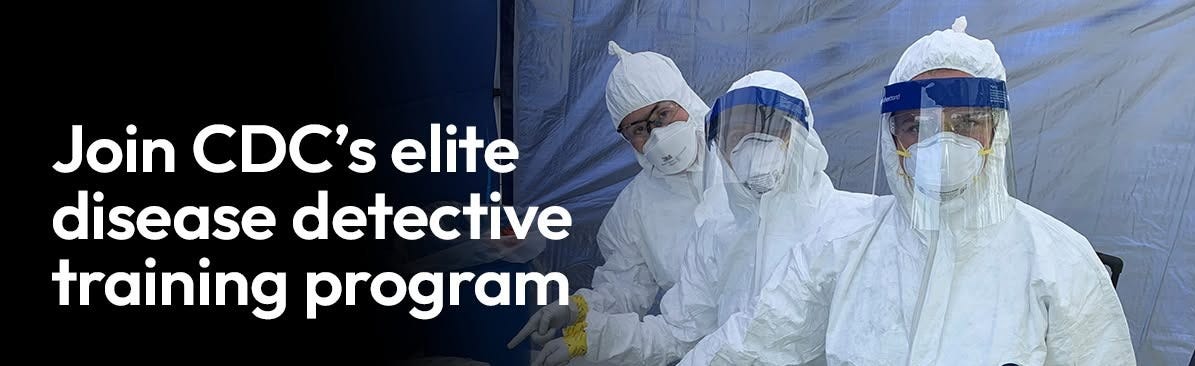
The CDC’s Epidemic Intelligence Service has run continuously ever since, carrying out largely the same mission and training over 4,100 “disease detectives” over the last 75 years. It is a two-year, salaried, post-doctoral fellowship for 40 to 50 scientists and healthcare professionals with a 10:90 ratio of typical schoolwork – classroom training, case studies, and exercises – and hands-on experience responding to actual epidemics and other field work. The goal of the program is to get fellows a crash course in applied epidemiology so that they can better serve not just the CDC but the broader field.
And serve they do: Alumni of the EIS run American public health. A 2022 study found that EIS alumni had filled 52 percent of a selected set of senior public health leadership positions during the 16-year period it examined — including four of the twelve people who have served as CDC director through 2016, 58 percent of CDC center directors, and 35 percent of state epidemiologists. EIS’ 2025 annual report echoes these same statistics. The EIS pipeline is the leadership pipeline for the agency and also for the broader discipline. It is not really possible to do field epidemiology at a senior level in the United States without having come through EIS or knowing the people who did.
The upshot: Even for a discipline as highly academic as medicine and public health, it has not been historically guaranteed that long-term education would produce the talent that the government needed. The CDC had to build its own, and this process yielded significant positive externalities for the entire field and at all levels of government – EIS, in a sense is not just a “bridging” program but it’s also something of a subsidy to state health departments. No individual state could likely run a program of this size and scope, but they need the talent it produces.
The Fed par-cooks its own economists
Perhaps most banal of all, however, is the way the Federal Reserve produces economists. Far from the flashy worlds of spies and Ebola, the Fed has a somewhat simpler problem: It needs to employ high-quality economists and it cannot pay them the salaries they might command on Wall Street. So, it had to figure out how to capture potential employees before they embark on the graduate and post-graduate work that will credential them for those roles in finance. It created a two-year Research Assistant program to do precisely that: Find high-potential talent, imbue them in the culture and institutions of the Fed, and then launch them into prestigious PhDs with the hope that some come back one day. Many do.
The program involves hiring highly competent (but decidedly early-career) talent with basic relevant skills but no expectation of prior work history in the field. During the program, they receive mentorship, learn to work in the Fed environment, and get a chance to further develop their own skills by working with Fed economists on real problems. Further, by the time the RAs are ready to move on, they will have been deliberately and consciously coached through the process of applying for and being accepted into PhD programs by the same people who could one day be their colleagues. This is a good deal for the students, but it’s also an imperative for the field of economics more broadly as it looks at the future of its own discipline and seeks to continue to develop new public-minded talent.
The RA program is not nearly as remunerative as other options available to these students in banking or consulting or elsewhere. It only works because of the demonstrated value of the development, mentorship, and a network of economists who will write letters of recommendation, and the implicit promise of a serious career on the back end. This program, then, is neither internship, nor apprenticeship, nor the kind of rigorous up-or-out system that some of the other government-led bridging programs offer – it is, rather, an investment in a cohort of potential employees with the hope that they will, in turn, invest back in the Fed. The Fed has chosen to compete for early career talent on developmental terms rather than on salary terms, and it works.
Bridge to somewhere
The cumulative effect of AI on early-career jobs remains unclear and will remain unclear for quite a while. Executives at Dropbox have declared that young hires are now more appealing because they are already so fluent with AI. But there is a good chance that firms will have to view this type of hiring more like IBM has recently cast it: As an investment in their future workforce. In other words, white-collar firms will need to adopt a new relationship with their talent pool: they must become both a producer and a consumer of talent.
And they can draw some lessons from the government’s experience in making that shift:
Differentiated mission & values matter greatly - Perhaps the single most valuable throughline in many of the government’s bridging programs is the mission and the brand of the agency doing the hiring. Each has a clear value proposition to applicants about why they should sign up for its long-term career path. It helps that the American people think the work of government is actually very cool – many agencies have enviable net favorability ratings among the general public, often led by the National Park Service. But companies can also build unique brands with employee superfans, and those who elect to create bridging programs should take seriously the imperative to market themselves this way. Some firms already succeed at this for industries much less exciting than space travel or diplomacy, like Epic in the case of health records systems or Trader Joe’s in the realm of groceries.
Long-term organizational health is critical - One corollary to the business imperative to be both a consumer and producer of talent is that it requires firms to be a good boss in the middle. Unlike, say, the military, where recruits are obligated to a long-term contract, the programs I’ve described above are mostly regular jobs from which someone could resign at any time for any reason (or no reason). As a result, for this bridging play to work, employers must be attentive to the long-term organizational health of their workforces. This can look, for example, like efforts to improve the quality of middle management at State or a focus on measuring and monitoring organizational performance indicators during periods of disruption, as the Biden administration did during the post-Covid return to office. There is a robust management literature for private employers to draw on here about the value of employee engagement; they should make use of it.
The development programs need to be agile - Foreign policy, epidemics, and conflict have all always moved quickly, with big changes happening on the order of weeks and months – much faster than any hiring process in any industry can accommodate. As a result, many of these programs have some flexibility built into the training provided during the “bridging” years. FSOs are sent to language schools and then on to posting based on need, not necessarily prior interest. EIS fellows are trained in evergreen methods of epidemic investigation (represented by a worn-out shoe) that are designed to upskill them more generally rather than prepare them for a specific world. For private employers, this type of optionality and commitment to general skills development – as opposed to something like a Registered Apprenticeship where the credential is pre-defined up-front – may be critical to ensuring that the staff in their bridging programs possess the right skills at the end of the process rather than merely the ones anticipated at the beginning.
None of this will be easy, but it’s easier to imagine employers taking this path than it is to imagine some of the more exotic proposals out there succeeding at scale. If the government can take matters into its own hands when forced into a corner by the realities of the labor market, so too can private employers.
Gabe Menchaca is a Senior Policy Analyst in the State Capacity Initiative at the Niskanen Center. He previously worked at the Office of Management and Budget in the Office of Personnel and Performance Management and as a Senior Advisor to the Deputy Director for Management.
 | A guest post by
|